Research program
A hammer or steel ball and a contact sensor cover the two lower-frequency regimes. For ultrasonic and coda measurements at 50–500+ kHz we are looking for partner laboratories.
Frequency bands and instruments
| Regime | Band | Source and receiver | Capture at 48 kHz |
|---|---|---|---|
| I · Flexural sounding | 0.3–16 kHz | Hammer or ball-peen strike; smartphone microphone or low-cost contact piezo | Below the 24 kHz Nyquist limit |
| II · Impact-echo | 2–20 kHz | Steel ball, 12–19 mm; contact piezo accelerometer and preamp on a USB-C 24-bit / 48 kHz analog-to-digital converter (ADC) | Below the limit. This is the planned $268 kit, which is not yet built |
| III · Ultrasonic and coda wave | 50–500+ kHz | Ultrasonic transducers or scanning laser Doppler vibrometry (SLDV) | Above the limit; partner measurements sought |
Regime I · Flexural sounding 300–16,000 Hz
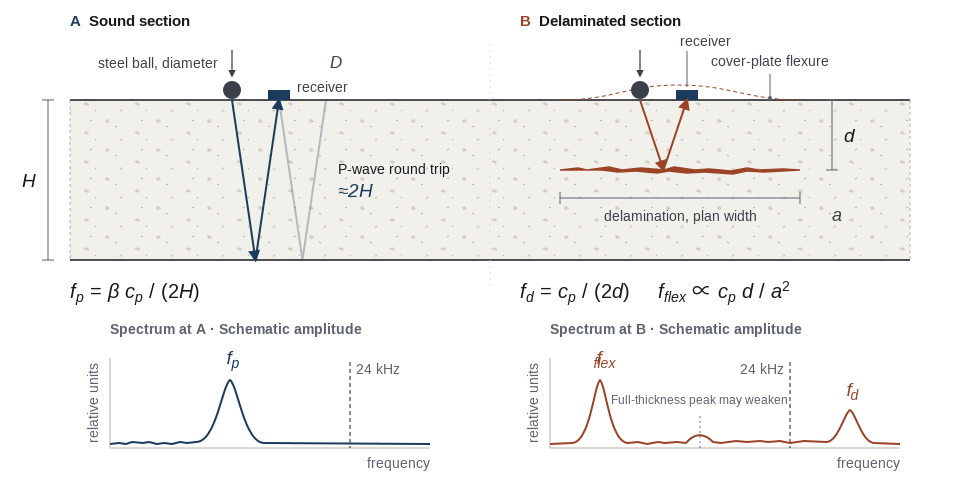
A shallow delamination or debonded layer leaves a thin cover that bends like a plate when struck. Its local flexural resonance falls at low frequency, where a smartphone microphone or a low-cost contact piezo can record it after a hammer strike. The targets are shallow bridge-deck overlays, mortar joints in brick masonry, and debonded tile and facade panels.
Regime II · Impact-echo 2,000–20,000 Hz
The same impact sends a P-wave through the thickness. Its repeated reflections between the two faces set up a resonance at fp = β cp / (2H), with β ≈ 0.96 for concrete plate geometry, so a measured peak gives the thickness once the wave speed is known. We use it to estimate full thickness and to detect delaminations 25–75 mm deep in 200–250 mm slabs.
The recording kit for this band pairs a contact piezo accelerometer and preamp with a USB-C 24-bit / 48 kHz ADC. Its hardware list is pre-registered at $268, and the kit has yet to be built.
Regime III · Ultrasonic and coda wave 50,000–500,000+ Hz
Above 50 kHz the wavelength shrinks toward the scale of the aggregate, and the wave scatters many times before it reaches a receiver. The late part of such a record, the coda, is sensitive to early micro-cracking: it decorrelates, and its relative velocity (dv/v) shifts. This is also the band that our neural-operator pilot, ElastoWave-NO, is meant to reach.
These measurements need ultrasonic transducers or SLDV, well outside what audio hardware can record.
We are looking for university partners who can record 50–500+ kHz ultrasonic or coda wavefields on characterized concrete or masonry specimens, so that the same specimens can also be measured at 0.3–20 kHz. The question is whether scattering and coda changes track damage that shows in the bending and thickness echoes. No joint measurement has been taken yet. Specimens and acquisition metadata
Reflections and cover-plate bending
In the first-order plate model, an impact over sound concrete produces one dominant thickness resonance. Over a delamination the model predicts a low-frequency flexural mode of the cover plate and a thickness branch that, for shallow flaws, lies above the audio band.
Studies
One rule holds across all of them: no slab, structure, or corpus appears on both sides of a train and test split.
Six-slab impact-echo comparison Pre-registered
A $268.00 recording kit built on a USB-C 24-bit / 48 kHz ADC will be measured against an Olson Instruments NDE 360 Impact-Echo reference on a 150 mm co-located grid. Four of the six slabs carry delaminations at 25–75 mm and two are sound controls.
Three targets were fixed before any data exist: a contact-sensor AUROC of at least 0.80, a total time reduction of at least 20%, and a difference of at most 10% in Professional Engineer (PE) review. Slab casting and field timing await institutional clearance. Hardware list, endpoints, and slab matrix
Audit of public impact-echo corpora
FHWA Bare Decks, IE2020, and Overlay IE2020 hold 5,370 parsed records but only 3,543 unique waveforms, because 1,796 records copy a waveform in another corpus. With each corpus held out in turn (leave-one-lab-out, LOLO), balanced accuracy lies between 0.5642 and 0.6636, and a probe trained to name the source corpus reaches 0.6765 against a majority-class rate of 0.5159. In the nested cross-validation, 0 of 23 outer folds met the support criteria.
Two analyses are still to run: conformal evaluation on archived records, and zero-shot transfer, in which a model trained on FHWA Bare Decks is applied without retraining to the dataset of Hui et al. Record counts and held-out accuracy
PhysNDE-Bench v1
Of 473 harvested catalog entries, 391 contain eligible, nonduplicate field data and 82 are quarantined. Two datasets under commercially permissible licenses supply held-out baselines. One holds out each of 8 slabs in turn (leave-one-slab-out, LOSO); the other holds out each of 2 reinforced-concrete (RC) structures (leave-one-structure-out, LSSO). Neither split has a leakage violation. Held-out baselines · Catalog audit
ElastoWave-NO: calibration on one GFRP plate
A neural-operator pilot on one glass-fiber-reinforced polymer (GFRP) chirp wavefield recorded by SLDV (Radzienski & Zhu, CC BY 4.0). On the 175 mm ring with k = 8, the finite-element (FE)-calibrated model reaches AUC 0.8761 and the scratch-calibrated model 0.8727. Because the pilot uses a single laboratory composite plate, the +0.0034 difference is descriptive and does not establish field performance on concrete. GFRP calibration results
CausalSHM: temperature and vibration frequency
Ambient temperature shifts a structure's modal frequencies, and a damage indicator has to stay calibrated through that shift. Each evaluation trains on earlier observations and tests on later ones. In FLOOD-SHAB, a monitoring record that logs air temperature beside the vibration modes, temperature and the first-mode frequency correlate at r = −0.563. The Vänersborg record supplies real fracture events, 8 healthy and 6 damaged, scored with plain, conformal, and adaptive conformal inference (ACI) variants. Environmental pilot datasets