Stress-wave evaluation of concrete and masonry structures.

A steel ball striking concrete sends a pulse through the slab. We study what its return can tell an engineer about a separation beneath the surface.

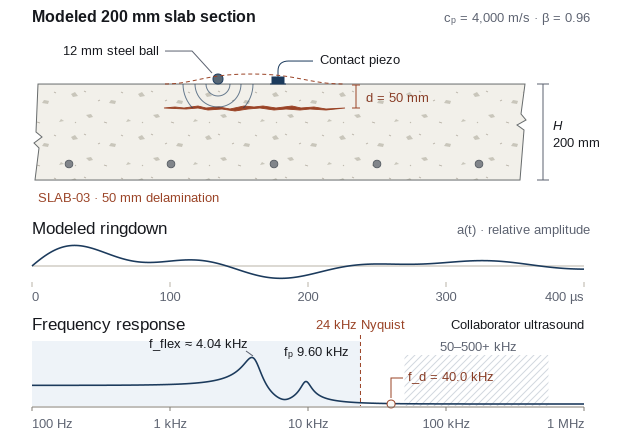
Cross-section of a 200 mm concrete slab with a 50 mm subsurface delamination, coupled damped acceleration response, and logarithmic frequency spectrum showing the 24 kHz Nyquist limit and the 50–500+ kHz ultrasonic band.
Modeled response of a 200 mm concrete slab with a 50 mm separation (cp = 4,000 m/s, 12 mm steel ball).

Repeated waveforms in public impact-echo data

Three public impact-echo corpora share a third of their records. Of 5,370 parsed records, 1,796 copy a waveform held in another corpus, which leaves 3,543 unique waveforms.

A model trained on one of these corpora and tested on another can therefore be tested partly on its own training data. With each corpus held out in turn, balanced accuracy stays between 0.56 and 0.66, and a classifier can still tell which corpus a waveform came from.

Table 1. Audit of the FHWA Bare Decks, IE2020, and Overlay IE2020 corpora.
Parsed records5,370
Copies of a waveform in another corpus1,796
Duplicates within a corpus31
Unique waveforms3,543
Balanced accuracy with one corpus held out (LOLO), native band0.5642–0.6636
Accuracy of a probe that names the source corpus (majority-class rate 0.5159)0.6765
Nested cross-validation outer folds that met the support criteria0 of 23

These results come from public data. Our own slab measurements have not started. Record counts and held-out accuracy
Which waves can the recorder capture?

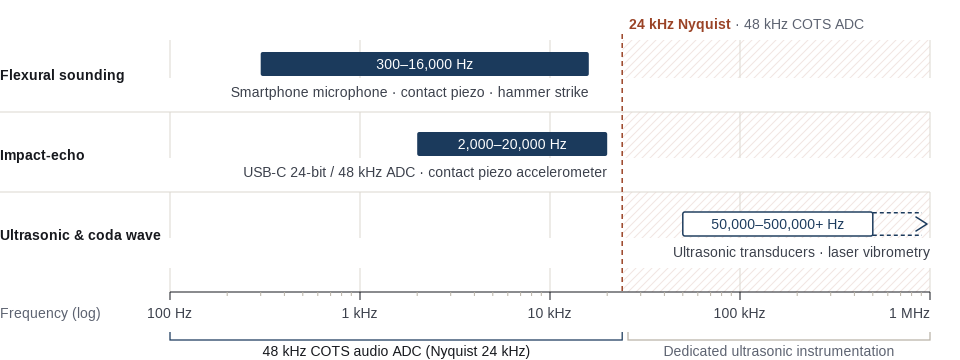
We work in two bands that an ordinary 48 kHz recorder can capture: flexural sounding at 0.3–16 kHz and impact-echo at 2–20 kHz. Ultrasonic and coda measurements at 50–500+ kHz need dedicated transducers, and for those we are looking for partner laboratories.

Logarithmic frequency axis from 100 Hz to 1 MHz. Regime I, flexural sounding, spans 300–16,000 Hz. Regime II, impact-echo, spans 2,000–20,000 Hz. Both lie below the 24 kHz Nyquist limit of a 48 kHz audio converter. Regime III, ultrasonic and coda wave, spans 50,000–500,000+ Hz, above that limit.
Figure 1. The planned 48 kHz recorder has a 24 kHz Nyquist limit. The ultrasonic band lies above it.

Compare sensors by frequency

Current studies

Six-slab impact-echo comparison

We plan to cast six slabs, four with delaminations at 25–75 mm and two sound controls, and measure each with a $268.00 commercial off-the-shelf (COTS) recording kit and an Olson Instruments NDE 360 Impact-Echo reference on the same 150 mm grid. The protocol is pre-registered; casting and field timing await institutional clearance.

Audit of public impact-echo recordings

The duplicate ledger, fold-support check, held-out baselines, and corpus-identity probe are complete, and the manuscript, Group-Disjoint Evaluation and Shortcut Risk in Public Impact-Echo Corpora, is in preparation. Two analyses remain: conformal evaluation on archived records, and a zero-shot transfer test in which a model trained on FHWA Bare Decks is applied without retraining to the dataset of Hui et al.

Three smaller pieces are complete: the PhysNDE-Bench v1 catalog of 473 harvested dataset entries, a calibration comparison on a composite plate, and a pilot on temperature and vibration frequency in two monitoring records.

Have a slab with a known delamination depth?

We would like to set ultrasonic or coda recordings at 50–500+ kHz beside our low-frequency recordings of the same specimen. If you have a concrete or masonry specimen with documented damage, or recordings of one, write to [email protected].

Specimen and recording details · Technical brief (1 page) · Study slides (6)